VISITING CASTLES


|
|
THE A40 DRIVE
The thirty-five miles between Crickhowell (just west of Abergavenny, which has its own ruined castle secreted just off the town center) and Llandovery skirt the Brecon Beacons National Park and offer grand views as well as the chance to meet some lesser known Welsh castles. Crickhowell, once a prosperous flannel-manufacturing center, is now a small but bustling market town. Arriving from the east, you cross the attractive medieval thirteen-arched bridge spanning the River Usk, a popular fishing spot. Immediately across the bridge, you should be able to identify the silhouetted grey stones of the castle, which sits off the road next to a large field to the left. Don't be dismayed if you pass by the castle on your first attempt; turn around and try again. A car park exists on the opposite side of the A40 from the castle. It is well placed for a walk to the castle. The local authority has taken great pains to preserve this fine structure.
At the western end of Crickhowell, the A40 narrows abruptly as it curves out of town. At the bend, the 15th-century fortified gateway of Porth Mawr, home of the prestigious Herberts, dominates the view. Only recently preserved and limewashed in medieval colors, its yellow walls makes the structure easy to spot. Nearby, on the northern side of the road, the White Hart Inn, a 15th-century coaching inn built originally to take tolls from passersby, offers excellent food and drink. A few miles west of Crickhowell, signs announce the approach of another fascinating medieval town, Tretower (or "Tretwr" in Welsh: "the hamlet of the tower"). The unique castle towers well above the land, a short distance off the A40 on the north side of the road. Even so, it's easy to pass the A479 turnoff – and frustrating when you then spot the castle in your rear-view mirror. The village itself seems little more than its castle and Tretower Court, the medieval home that superseded the stronghold. Tretower Castle is an unusual site, and is actually composed of two nested castles lying amidst of a group of modern farm buildings. To gain access, you must pass through Tretower Court (fee) and then across the grassy field to the castle. The earthen embankments and chunks of the original stonework that lie between the castle and the medieval residence formed the outer defenses of the stronghold.
Tretower's compact 12th-century shell keep once contained an impressive array of buildings, including a kitchen, the hall, and private apartments. In the 13th century, the four-story round keep was erected inside the remains of the shell keep. Incorporating some of the masonry remains of the shell keep, the new tower featured nine-foot thick walls, a basement for storage, a well, decorative windows and fireplaces, and two stairways. Nonetheless, by the 14th-century, the site became obsolete as a home, and the neighboring manor house was constructed as its replacement. About twenty miles west of Tretower (and eleven miles west of Brecon, where portions of the medieval castle have been transformed into a hotel), the A40 passes rapidly through Trecastle (the "hamlet of the castle," Trecastell in Welsh). Tiny Trecastle had a long and active history, due to its strategic location as a crossroads. The site was especially favored by the Romans, whose roadway, Sarn Helen, passed through the region, and later the Normans erected their own stronghold along the road. Camouflaged by trees and a naturally rocky appearance, the castle in Trecastle sits high over the A40. (In fact, it practically overhangs the road.) The earthworks are extensive, and you may even be able to hike a bit of Sarn Helen. The A40 twists away from Trecastle towards Llandovery (Llanymddyfri, "the church among the waters"). According to the 19th- century traveler, George Borrow, the "small but beautiful town situated amongst fertile meadows" was "the pleasantest little town in which I have halted in the course of my wanderings." Llandovery's early 12th century motte and bailey castle is conveniently located behind a large car park on the south of the roadway. Both structures are intact and accessible. The motte was eventually crowned with a D-shaped tower and encircled with stone walls.
Perched atop a limestone crag, the 13th-century stronghold is visible for miles. Crossing through a farmyard and trudging up the steep path to the castle can seem rather daunting, until you reach the top and look out upon the spectacle of the Welsh countryside. Yet, this is the perfect site for a castle. The medieval garrison would have been able to detect an enemy well before an attack, and the sheer slopes of the craggy hillside should have thwarted any serious siege. Ironically, despite the location, Carreg Cennen fell several times to the English and to the Welsh from the late 13th to early 15th centuries. Like most castles, Carreg Cennen's interior is now ruined, but one curious feature survives. A long, narrow passage runs through the inside of the bedrock to a large underground cave. Fitted with walls and stairs during medieval times, the cave's purpose is still a mystery. Some stories claim that it once provided a secret access point outside the castle, but the physical evidence for this is inconclusive at best. Also built by the Princes of Deheubarth, Dryslwyn Castle dominates the scenery about seven miles west of Carreg Cennen just off the A40 on the winding B4297. From a distance, Dryslwyn is easy to locate, for it commands the summit of an isolated hillock, which overlooks the River Towy and is surrounded by the hardy floodplain. The castle's strategic placement, particularly its visibility from Carreg Cennen, allowed soldiers at either site to signal each other when an enemy approached. Only recently excavated and preserved, the castle is a complete ruin, with bits and pieces exposing how rugged life must have been during the Middle Ages. Surprisingly complex, the hillock is literally strewn with ruins. Especially interesting are the extensive remains of the associated medieval fortified town built alongside the castle. Exploring a medieval castle allows modern-day visitors to transport themselves back in time. The earthworks and stones stand in bold testimony to the vigor of the people who built the castles, and perhaps even more significantly, they emphasize the resilience of the people whose homelands were overtaken. Originally published in Ninnau, the North American Welsh Newspaper |
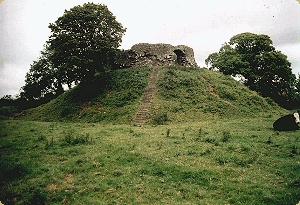 Virtually every Welsh town or village has its own castle, not necessarily a massive and imposing stone fortress like Conwy or Caerphilly, but, at the very least, the remains of an earth and timber motte castle. In many instances, as at Wiston in Pembrokeshire or Cardiff, the capital of Wales, these Norman-era castle mounds are still topped with a simple stone keep or surrounded by a bailey, a large enclosed area where most of life's activities occurred. Oftentimes, you will find them standing very distinctively within a flat, green field. You can even spot mottes alongside the motorway if you are alert. (Hint: Watch for the motte named Talybont, worn down by rain and wind, that still exists on the southern side of the M4, just before the exit to the A4138; at first glance, it looks just like a pile of dirt, but a closer look reveals its medieval origins, and its unnatural location in an otherwise grassy field).
 One of the best routes for exploring castles in Wales is the A40, a scenic roadway that winds through the Brecon Beacons, swinging past Black Mountain (near Carreg Cennen Castle), wooded valleys, lush hillsides, and rich farmlands. While some castles, like mighty Raglan, proudly overlook the road and are easy to see from a distance, others take an observant, knowing eye to detect. Each discovery makes the journey all the more exciting.
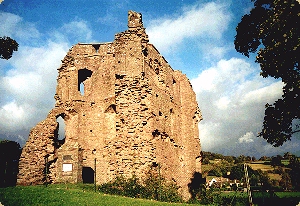 Built by the Normans, Crickhowell's motte and bailey date to the early 12th century. From the A40, it seems as if little remains. In fact, while the castle is very ruined, not only does a large double tower survive, but remnants of the original gatehouse also exist. Today, the motte has lost some of its original height, thanks to the weather and the aging process, but the mound is still crowned by fragments of a stone shell keep. From the top, one can enjoy the fine views of the surrounding area.
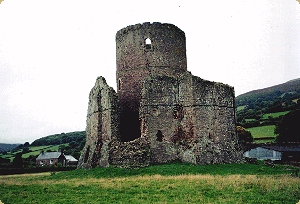 Erected about 1100, the first castle at Tretower was a Norman motte, which was probably crowned with a timber tower. Situated in a very marshy spot, most of the motte has eroded away, and none of the timber structures survive. In the mid-12th century, the owners replaced the vulnerable wooden fortifications with masonry defenses. Today, the remains of two stone towers dominate the site, an older shell keep and the taller, cylindrical keep, sitting inside. Portions of the original curtain wall also exist in and around the farm structures.
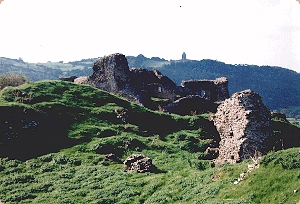 Driving another twenty miles west on the A40 toward Carmarthen, you can explore two formidable Welsh-built castles, Carreg Cennen and Dryslwyn, relics of the Age of Welsh Princes. Some castle-hunters consider Carreg Cennen the crowning glory of southwest Wales, especially with its ties to the Welsh Princes of Deheubarth. Located about four miles south of the A40 near Llandeilo and close to Trapp, Carreg Cennen offers spell-binding vistas of Black Mountain and the stunning panorama of the Brecon Beacons National Park. The views alone make the challenging climb to the castle worth the effort.